
Content Showdown: AI vs. Traditional Writing in 2026 — Which pays better?
Content creation has undergone a dramatic transformation. With the rise of advanced AI writing tools, creators and businesses now face a critical choice: leverage artificial intelligence or stick with established human writing methods.
This decision goes beyond mere technological preference. It impacts content quality, production speed, audience engagement, and even your brand’s trustworthiness.
For more blog posts like this, check here…
It’s without a doubt that understanding the deep distinctions between AI and traditional writing is essential for any successful content strategy in today’s digital ecosystem, but which of those actually gives a better result and pays better?
Let’s discuss this further.
Understanding Traditional Writing
Traditional writing refers to text created entirely by human authors without algorithmic assistance. It relies on human creativity, topic expertise, and personal style to produce original content. That is content made directly from journalism and technical writing to marketing copy and creative fiction.
What traditional writing style offers:
- Originality & Storytelling: Human writers craft truly original narratives based on personal experience and emotional intelligence to create meaningful connections that AI cannot replicate.
- Higher Content Accuracy: Humans critically analyze sources, make nuanced judgments, and perceive subtle contextual variants that affect interpretation.
Challenges of Traditional Writing
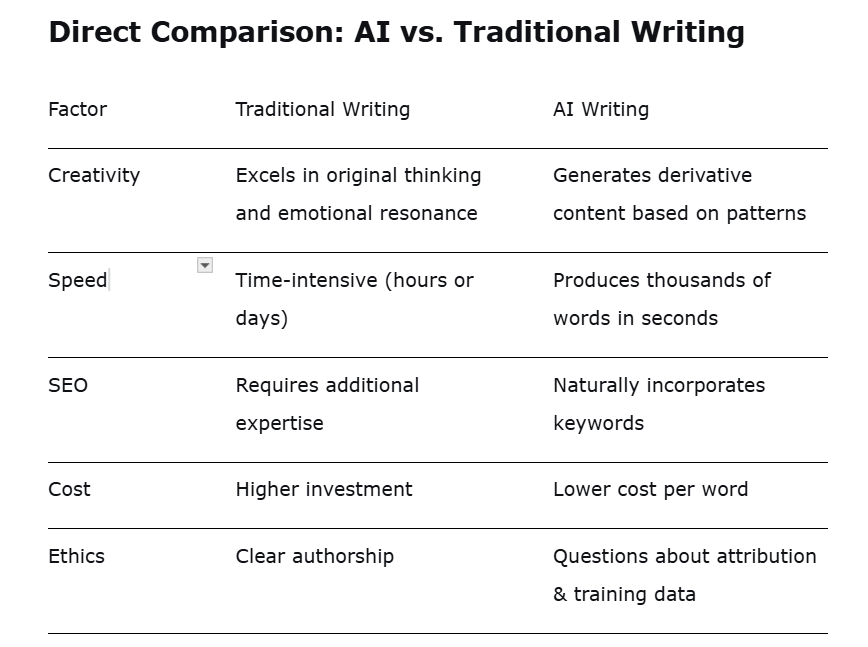
- Time-Consuming: Quality content requires significant investment in research, drafting, and editing, which can be tedious for businesses needing rapid updates.
- Higher Costs: Professional writers command fair compensation for their craft, making a full team of creators and editors a substantial financial investment.
Understanding AI in Content Creation

AI content writing uses algorithms and natural language to generate text with minimal human involvement. Advanced machine learning systems analyze billions of text datasets to learn language patterns and domain-specific information.
Tools like GPT-4, Claude, and Jasper can generate content ranging from blogs to technical documentation.
What AI writing offers:
- Speed & Efficiency: AI can generate thousands of words almost instantly, allowing companies to scale content rapidly and react to trending topics in real time.
- Cost-Effectiveness: Producing high-volume content with AI costs significantly less than producing the same content with professional human writers.
- SEO Optimization: AI tools naturally incorporate target keywords and SEO best practices, helping with search rankings.
Limitations of AI writing
- Lack of Creativity: AI struggles with truly fresh metaphors, original perspectives, and real emotional depth, often producing formulaic text.
- Accuracy & Misinformation: AI systems may confidently present biased or incorrect information. Without human verification, this can damage a business’s reputation.
- Ethical Concerns: Questions arise around intellectual property, authorship, and the potential replacement of human jobs.
What Google Thinks: AI Content & SEO
Can Google detect AI content? Yes. Google now emphasizes E-E-A-T (Experience, Expertise, Authoritativeness, Trustworthiness) as key ranking factors. While Google doesn’t automatically penalize AI content, it favors content demonstrating high-level expertise and unique value—qualities more likely found in human writing.
Recent helpful content updates penalize content made for search engines rather than human consumption. Red flags include:
- Data stuffing
- Surface-level topic treatment
- Aggregation without added insight
Best Practice for AI content is using it as a starting point, not the finish line. Incorporate human editing, fact-checking, and original insights while focusing on providing user value, not manipulating search engines.
Reach out to us here to hire Prowriterteam for content writing…
2026 Test: Is AI Content Actually Good?
A recent hands-on test compared two AI writing tools against human-written content on the topic “how to perform an SEO audit.”
Test Subject #1 (Paid SEO Platform):
- Produced a 5,600-word draft with an A- Clearscope score.
- Problem: The draft couldn’t decide on its audience—using basic analogies for beginners while demanding access to highly technical tools. It was also repetitive and verbose.
Test Subject #2 (Free AI Chat Tool):
- Did a better job sticking to a consistent tone and audience.
- Problem: Factual inaccuracies. The AI hallucinated pricing information for tools like Ahrefs and Semrush and made contradictory statements.
Verdict: Neither tool would serve a website well for long-term SEO. Tool #1 lacked audience focus; Tool #2 included damaging errors. Publishing inaccurate content won’t get your site cited by search engines or AI tools—and it erodes brand trust.
Why Human Expertise Still Wins Over AI
AI can generate words, but only humans create content that truly connects.
- Creativity & Fresh Ideas: Humans think beyond patterns, drawing from personal experience and cultural trends.
- Audience Understanding: Skilled writers adjust language and depth for beginners versus experts. AI produces generic middleground drafts.
- Emotional Intelligence: Humans use empathy to build comfort, urgency, or excitement. AI can imitate tone but doesn’t understand feeling.
- Persuasive Storytelling: Real customer experiences and anecdotes drive action. AI lacks lived experience.
- Adaptability: Human writers adjust quickly to market shifts and new regulations. AI often lags on outdated data.
Effective content needs a clear audience—and AI drafts often miss this entirely. However, there’s a chance that this might change in the future based on the rate at which AI is improving.
Visit Prowriterteam here for more writing insights…
The Future of Content Creation (AI or Human Writing)
The writing profession is changing as a result of pressure from AI, but demand is growing for human expertise in creative direction, strategy, and specialized knowledge. Successful creators are developing hybrid workflows — using AI for efficiency and human judgment for quality assurance.
The most valuable human skills moving forward will be authentic perspectives, emotional intelligence, and strategic vision — qualities algorithms cannot replicate.
Final Thoughts
The debate between AI and traditional writing is not about “either/or” but “context.” Both have strengths:
- Choose AI for speed, consistency, and budget-friendly volume.
- Choose Human Writers for creativity, emotional connection, and deep expertise.
The most effective modern content strategies use a combination: leveraging AI to augment human capability, not replace it. Machines handle repetitive tasks; humans bring strategy, accuracy, and the storytelling that builds lasting trust.