
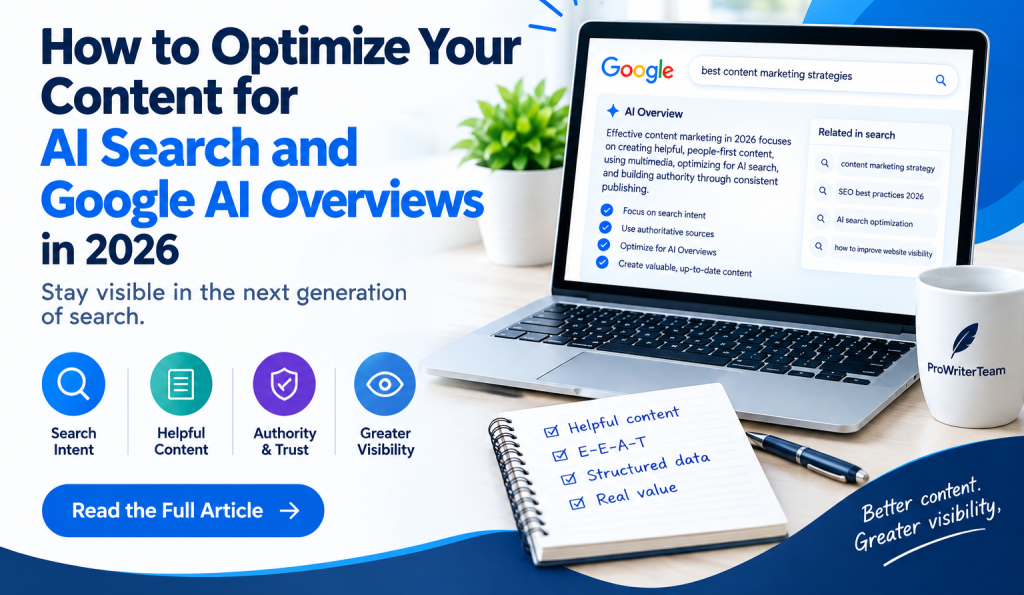
Search is changing quickly.
People are no longer relying exclusively on traditional blue-link results. Google’s AI Overviews and AI Mode can summarize information, answer complex questions, and provide links to supporting websites. Google says the fundamental SEO practices that have always mattered helpful, reliable, people-first content, crawlability, internal linking, strong page experience, and accessible text remain relevant for these AI search experiences.
For businesses, publishers, bloggers, and marketers, this creates an important question:
How do you create content that remains visible when search engines increasingly use AI to answer users’ questions?
The answer isn’t to abandon SEO or fill every article with AI-generated text.
Instead, businesses need to create genuinely useful content that clearly satisfies search intent, demonstrates expertise, provides original value, and is easy for both people and search systems to understand.
This guide explains how to optimize your content for AI search and Google AI Overviews in 2026.
Want Prowriterteam to review your marketing tool? Reach out to us here!
What Is AI Search?
AI search refers to search experiences that use artificial intelligence to understand queries, retrieve information, generate answers, and help users explore a topic.
Google’s AI Overviews and AI Mode are examples of this development.
AI Overviews provide an AI-generated summary for certain searches and include links that allow users to investigate the information further. AI Mode is designed for more complex exploration, reasoning, and comparisons. Google explains that these systems can use multiple related searches to build a response and identify supporting pages from its search index.
This means your content may be discovered and referenced in ways that differ from a traditional search result.
Is Traditional SEO Still Important?
Yes.
One of the biggest misconceptions about AI search is that traditional SEO has become irrelevant.
Google’s own documentation says the opposite. Its AI search features are built on its existing Search systems, and the foundational SEO practices remain important. There are also no special technical requirements or special AI schema required to appear as a supporting link in AI Overviews or AI Mode.
That means businesses shouldn’t abandon:
- Keyword research
- Search intent
- Internal linking
- Technical SEO
- Helpful content
- Page experience
- Clear site architecture
- Original research
- Author expertise
- Accurate information
Instead, these fundamentals should become part of a broader content strategy designed for both conventional search and AI-powered discovery.
1. Understand Search Intent Before Writing
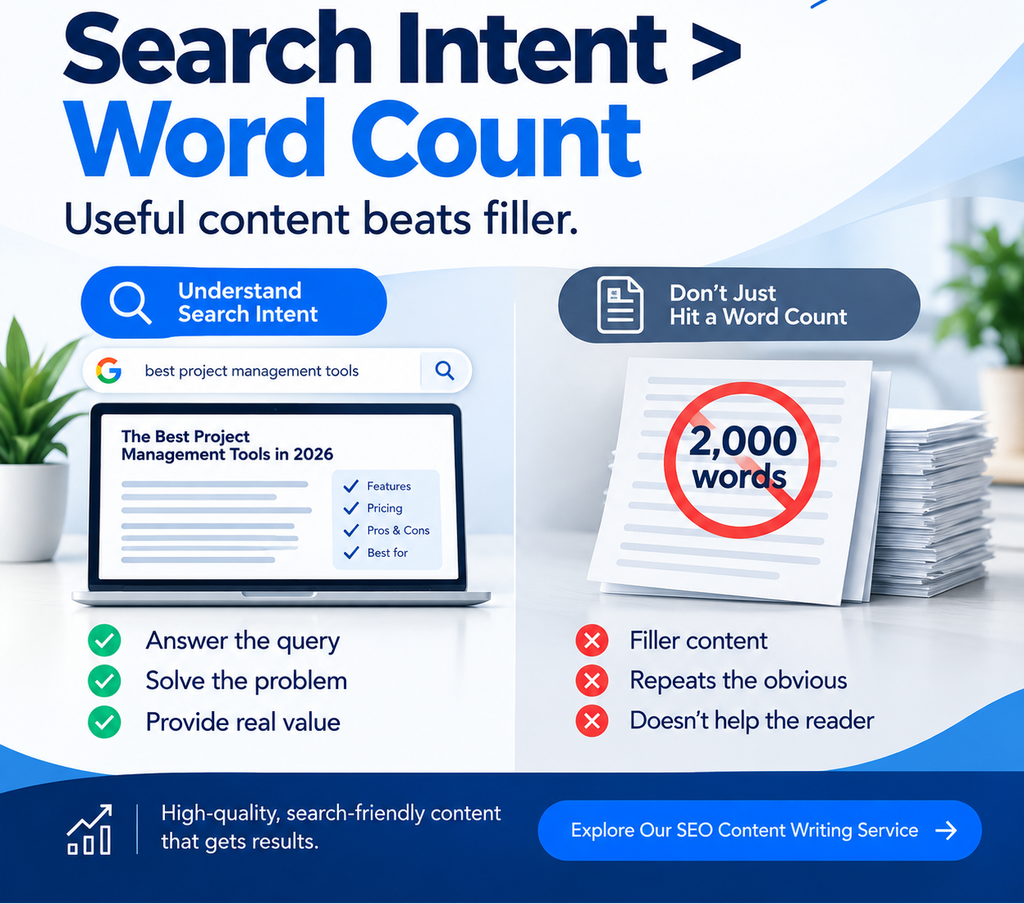
Search intent should be the starting point for every serious SEO article.
Before creating content, ask:
What is the searcher actually trying to accomplish?
A keyword can have several possible meanings.
For example, someone searching for “SEO content writing” might want:
- An explanation of SEO writing
- Tips for writing SEO articles
- An SEO content writer
- An SEO writing service
- Examples of SEO content
- A comparison of writing tools
If your article answers the wrong question, excellent writing alone won’t solve the problem.
Match the Content to the Intent
Identify whether the search is primarily:
Informational — The user wants to learn something.
Commercial — The user is researching a product or service.
Transactional — The user is ready to take action.
Navigational — The user wants to find a particular website or resource.
Then structure the article around that objective.
2. Answer the Main Question Early
Don’t make readers work through five paragraphs before discovering the answer.
A strong introduction should quickly establish:
- What the topic is
- Why it matters
- What the article will explain
- What the reader should expect to learn
This also creates a clear topical foundation for search systems.
For example, if your article targets “how to optimize content for AI search,” the introduction should immediately explain the relationship between traditional SEO, AI search, and helpful content.
Then expand on the topic.
3. Create People-First Content
Google’s guidance emphasizes helpful, reliable, people-first content. Its generative-AI guidance also warns against producing large numbers of pages with little added value.
That distinction is increasingly important.
Publishing 50 generic articles isn’t necessarily better than publishing 10 genuinely useful resources.
Your content should provide something the reader can actually use.
That might include:
- Original research
- Examples
- Expert commentary
- Case studies
- First-hand experience
- Data
- Comparisons
- Step-by-step instructions
- Unique analysis
The objective is not simply to produce more words.
The objective is to produce more value.
Need a high quality SEO content written for you? Prowriterteam has got you covered.
4. Demonstrate Experience and Expertise
AI search makes credible information particularly important.
Whenever appropriate, demonstrate why your content deserves attention.
For example:
- Identify the author
- Explain relevant experience
- Cite credible sources
- Use original examples
- Include data
- Explain methodology
- Update outdated information
- Correct mistakes when necessary
If you’re writing about SEO, don’t simply repeat what hundreds of other websites already say.
Add your own analysis.
5. Use Clear Content Structure
A well-structured article is easier for readers to scan and easier for search systems to understand.
Use:
H2 headings
For major sections.
H3 headings
For supporting topics.
Short paragraphs
Avoid walls of text.
Lists
Use bullet points and numbered steps when appropriate.
Tables
Use tables when comparing products, features, prices, or options.
Examples
Show readers what you’re talking about rather than relying entirely on abstract explanations.
Google specifically recommends ensuring important content is available in textual form and that important pages are easy to discover through internal links.
6. Build Topic Depth Instead of Keyword Stuffing
Modern SEO isn’t about repeating the same keyword dozens of times.
Instead, cover the topic comprehensively.
If you’re writing about AI search optimization, relevant subtopics might include:
- AI Overviews
- AI Mode
- Search intent
- Helpful content
- Internal linking
- Original research
- Author expertise
- Content freshness
- Structured information
- Technical SEO
- User experience
- AI citations
This creates a more complete resource.
Use keywords naturally where they make sense.
Don’t force them into every paragraph.
7. Add Original Information
One of the strongest ways to differentiate content is to provide information that isn’t simply rewritten from other websites.
Consider adding:
- Your own tests
- Screenshots
- Surveys
- Customer experiences
- Expert interviews
- Original statistics
- First-hand observations
- Case studies
Google’s 2026 guidance specifically highlights the importance of valuable, unique, non-commodity content when optimizing for generative AI features.
Check out other Prowriterteam articles and reviews here.
8. Strengthen Internal Linking
Internal links help readers discover related information and help search engines understand relationships between pages.
For example, an article about AI search could link to:
- Your SEO content writing service
- Your keyword research guide
- Your content strategy article
- Your SEO writing guide
- Related AI marketing articles
Think of your website as a network rather than a collection of isolated articles.
A strong content cluster could look like:
AI Search Optimization
↓
AI Overviews Guide
↓
Search Intent Guide
↓
SEO Content Writing Guide
↓
Internal Linking Guide
↓
Content Strategy Guide
↓
SEO Content Writing Service
9. Keep Content Fresh
Search behavior changes.
Tools change.
Features change.
Statistics become outdated.
Your article should therefore have a maintenance process.
Review important pages periodically and update:
- Statistics
- Product information
- Screenshots
- Pricing
- Examples
- Links
- References
- Outdated recommendations
Freshness should not mean changing an article simply to make it look new.
Make meaningful improvements.
10. Use AI as a Tool, Not a Replacement for Value
AI can help with:
- Research
- Brainstorming
- Outlining
- Editing
- Summarizing notes
- Identifying gaps
- Generating ideas
But automatically producing large quantities of pages without adding value can create quality and spam-policy problems. Google specifically advises publishers using generative AI to focus on accuracy, quality, relevance, and added value.
The strongest workflow is often:
Research → Human strategy → AI assistance where useful → Expert writing/editing → Fact checking → Optimization → Human review
The technology can accelerate the process.
It shouldn’t eliminate editorial judgment.
11. Optimize for Citability
If you want your content to have a chance of being referenced by AI search systems, make important information easy to understand.
For example, instead of writing:
“Many experts believe that search is changing significantly because of developments in artificial intelligence.”
Write:
“Google’s AI Overviews and AI Mode use generative AI to provide answers and supporting links for certain searches.”
Then explain the evidence and context.
Clear statements are easier to understand than vague claims.
12. Don’t Forget Technical SEO
Content quality alone isn’t enough.
Make sure important pages can be:
- Crawled
- Indexed
- Rendered
- Accessed by users
- Discovered through internal links
Google states that a page must be indexed and eligible to appear in normal Google Search to be eligible as a supporting link in AI Overviews or AI Mode.
Check:
- Robots.txt
- XML sitemap
- Canonical tags
- Indexing
- Mobile usability
- Page speed
- Broken links
- Internal linking
- HTTPS
- Structured data
13. Optimize Images and Other Media
Text remains fundamental, but useful supporting media can improve the overall experience.
Depending on the topic, consider:
- Original images
- Screenshots
- Infographics
- Charts
- Videos
- Diagrams
Google recommends supporting textual content with high-quality images and videos when applicable.
Don’t add images simply to fill space.
Make them useful.
14. Measure Visibility Beyond Traditional Rankings
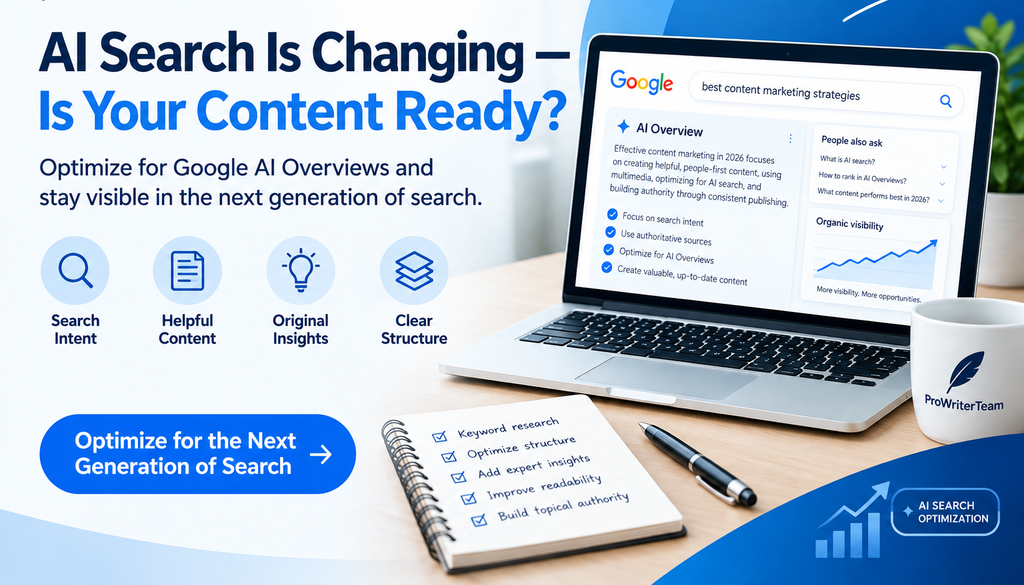
SEO measurement is evolving.
Ranking position and organic clicks remain important, but businesses should increasingly consider how their content appears across newer search experiences.
Google announced dedicated Search Console reporting for visibility in generative-AI features such as AI Overviews and AI Mode in 2026.
This gives website owners another way to understand how their content is being surfaced.
Track:
- Organic impressions
- Organic clicks
- CTR
- Rankings
- Conversions
- Assisted conversions
- AI-search visibility where available
- Brand mentions
- Content engagement
The goal isn’t simply to be visible.
The goal is to be visible to the right audience.
Common AI Search Optimization Mistakes
Writing only for algorithms
Content should ultimately serve people.
Publishing generic AI-generated articles
Automation without meaningful value can create low-quality content.
Ignoring search intent
A well-written article can still fail if it answers the wrong question.
Chasing word count
A 1,000-word useful article can be more valuable than a 3,000-word article filled with repetition.
Neglecting internal links
Don’t let useful articles become isolated pages.
Using outdated information
Especially important for technology, software, SEO, and marketing topics.
Forgetting conversion intent
Traffic isn’t the only objective. Business websites should connect useful content to relevant products and services.
Frequently Asked Questions
Does SEO still matter with AI Overviews?
Yes. Google states that existing SEO fundamentals remain relevant to AI Overviews and AI Mode.
Is there a special schema for AI Overviews?
Google says there is no special schema or additional technical requirement specifically needed to appear in AI Overviews or AI Mode.
Should I use AI to write my SEO articles?
AI can assist with research, planning, and drafting, but content should still meet quality, accuracy, relevance, and originality standards.
Does word count matter for SEO?
There is no universal word count that guarantees rankings. Focus on satisfying search intent and covering the subject as thoroughly as necessary.
How can I improve my chances of appearing in AI search?
Create helpful, original, authoritative content, maintain strong technical SEO, make important information accessible in text, and build clear internal links.
Final Thoughts
AI search isn’t making SEO obsolete.
It is changing how information is discovered and consumed.
Google’s current guidance makes one point particularly clear: the fundamental principles of good SEO still matter. Websites should focus on technically accessible pages, useful information, strong structure, credible sources, and people-first content.
The businesses that adapt successfully won’t necessarily be the ones publishing the most content.
They’ll be the ones publishing content that genuinely answers questions, demonstrates expertise, provides original value, and gives readers a reason to trust the source.
At ProWriterTeam, we help businesses create SEO-focused content designed around search intent, audience needs, and business objectives.
Need high-quality SEO content for your website? Contact ProWriterTeam today.
Want to support Prowriterteam?
BTC (bc1qdax3k5l8095lcpht78susuexes605vrmquelym)
ETH (0x876c890aD8EE8a6DDa6c74cAd76b0c4e7F990CD5)